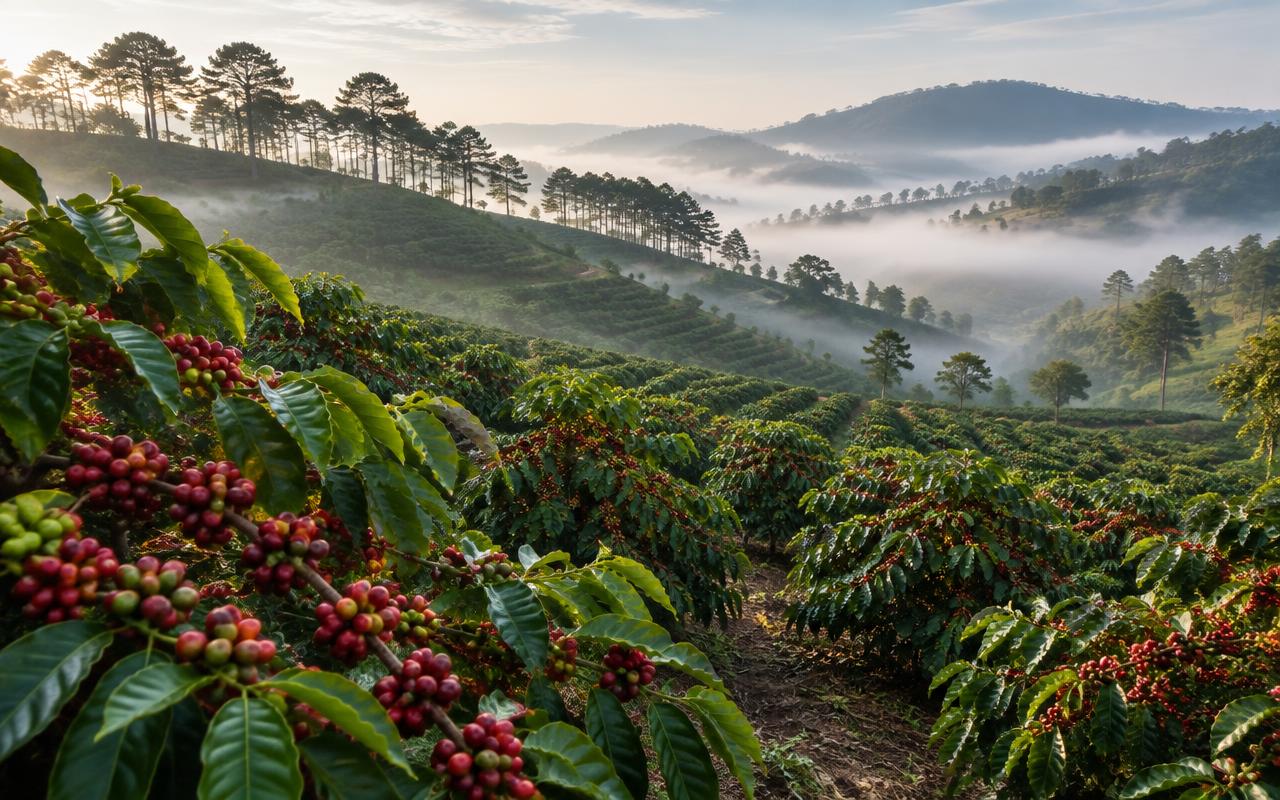
Vietnam
The world's second-largest producer — and a rising specialty story.
Vietnam is the world's second-largest coffee producer — around 30 million bags a year — yet remains specialty coffee's most underrated story. The Central Highlands around Đắk Lắk and Lâm Đồng produce the robusta that powers the global instant and espresso industries, while a new generation of producers in Đà Lạt is quietly building a serious specialty Arabica sector.
Robusta is Vietnam's backbone and its pride. Grown at 500–1,000 meters, Vietnamese robusta delivers the dark chocolate, molasses, and walnut intensity that defines the country's own café culture — the slow-drip phin filter, cà phê sữa đá with condensed milk, and Hanoi's famous egg coffee. Fine robusta lots, carefully harvested and processed, now score 84+ and are changing how the specialty industry thinks about the species.
The Arabica story centers on Đà Lạt and the Lang Biang plateau at 1,400–1,600 meters, where Catimor, Bourbon, and Typica lots are washed and honey-processed with increasing precision. Volumes are small but growing, and several producers have begun exporting traceable microlots directly to specialty roasters in Europe, Australia, and the US.
Harvest runs October through January. For roasters, Vietnam offers something rare: a high-volume origin with genuine specialty upside, direct-trade infrastructure that improves every season, and a domestic café culture — one of the world's most vibrant — that keeps quality incentives local.
Inside Vietnam
| Region | Altitude | Varietals | Processing | Harvest |
|---|---|---|---|---|
| Đà Lạt (Lâm Đồng) | 1,400–1,600m | Catimor, Bourbon | Washed, Honey | Oct–Jan |
| Đắk Lắk (Buôn Ma Thuột) | 500–800m | Robusta | Natural | Oct–Dec |
| Sơn La | 900–1,200m | Catimor | Washed | Oct–Jan |
How to brew it
Try Vietnamese robusta the local way: a phin filter, 1:5 ratio over condensed milk for cà phê sữa đá. A washed Đà Lạt Arabica, brewed 1:16 at 92°C, shows cocoa, dried fruit, and a clean sweet finish.
Full brew guides →